






How to Legally Transfer a Firearm in 2026 — Online, Private, $50 Flat
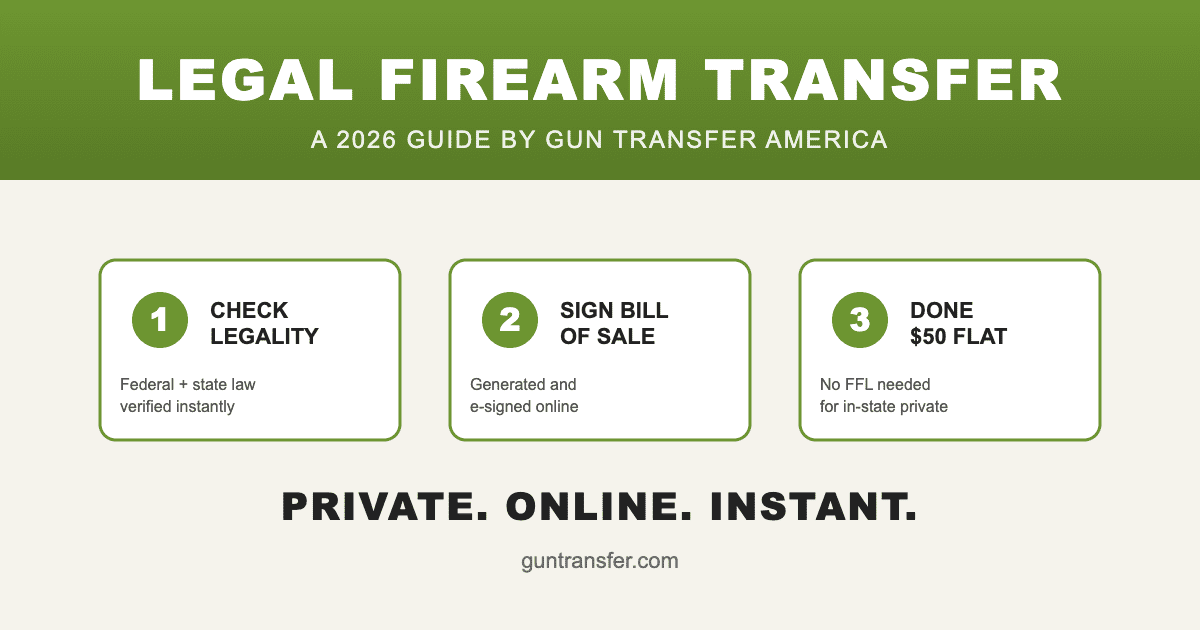
A legal firearm transfer in 2026 doesn’t have to mean driving to a gun shop, paying an FFL, and waiting days for paperwork. GunTransfer.com handles in-state private firearm transfers online, instantly, for $50 flat — including a court-recognized bill of sale, a built-in state legality pre-check, and identity verification for both parties. This guide explains what counts as a legal firearm transfer under federal law, when our online service applies, when you still need an FFL, and the common mistakes that turn lawful firearm transfers into federal felonies.
What is a legal firearm transfer?
A legal firearm transfer is any change of firearm possession that lasts beyond a brief, supervised, in-person handoff. Selling someone a rifle is a transfer. Gifting your son a shotgun for his birthday is a transfer. Trading pistols with a friend is a transfer. Even lending a gun to your neighbor for a hunting weekend is technically a firearm transfer under federal law, though a narrow exception applies for temporary supervised use during lawful sporting activities.
What is not a transfer: handing your friend your rifle at the range so they can shoot it while you stand right next to them, returning a firearm to its lawful owner, or moving a gun within your own household. The line federal law draws is whether possession changes hands in a way that gives the new person independent control. The instant they could walk away with the firearm and use it without you, you’ve transferred it.
This matters because firearm transfers — not purchases, not ownership, not possession — are what trigger background check requirements and FFL involvement under federal law. Get the legal firearm transfer concept right and the rest of the regulatory structure makes sense.
How Gun Transfer makes a legal firearm transfer instant
GunTransfer.com was built to take the friction out of legal firearm transfers between private parties in the same state. The traditional path — find an FFL, drive to their counter, fill out paperwork, wait for a background check, pay $25 to $75 in transfer fees, drive back — takes hours of your time and days on the calendar even when an FFL isn’t legally required. Our online service replaces that with five minutes on a phone.
- $50 flat fee — no per-firearm charges, no FFL haggling, no surprise add-ons.
- Online and instant — both parties complete their portion of the firearm transfer from anywhere; no shop visit required.
- Private — your transfer documentation stays between the buyer, seller, and GunTransfer. No FFL filing cabinet, no Form 4473 sitting in storage.
- State legality pre-check — before either party signs anything, our system confirms that a private transfer is legal in your state and your specific circumstances. If it isn’t, we tell you and refund you.
- Court-recognized bill of sale — auto-generated with both parties’ identities verified, the firearm’s serial number, and time-stamped digital signatures.
- Identity verification — government-issued ID checked on both ends, so neither party has to wonder if they’re selling to a prohibited person.
The result is a legal firearm transfer that’s faster, cheaper, more private, and just as defensible in court as one processed through a licensed dealer — when state law allows private transfers in your state.

When you can use Gun Transfer for a legal firearm transfer
GunTransfer handles in-state private firearm transfers in states where private-party transfers are legal under state law. That covers most of the country — but the rules vary. Roughly a dozen states require all firearm transfers, including private sales, to be processed through an FFL or licensed dealer with a NICS background check. Several others impose this requirement only on handguns, only at gun shows, or only in specific circumstances.
Before you start a legal firearm transfer on GunTransfer, our system runs an automatic state legality check based on the residency of both parties. If a private transfer is permitted, the platform proceeds. If your state requires an FFL or you’re trying to do something that crosses state lines, we tell you exactly that and point you to a licensed dealer instead. For the full state-by-state breakdown of private transfer rules, see our 50-state gun laws reference, which tracks each state’s private sale, registration, waiting period, and background check requirements.
Skip the FFL. Transfer your firearm online for $50.
If you’re doing an in-state private firearm transfer in a state where it’s legal, you don’t need to drive to a gun shop. GunTransfer handles the bill of sale, identity verification, and state legality check online — instantly — for $50 flat.
When you still need an FFL for a legal firearm transfer
GunTransfer doesn’t replace FFLs in three specific situations, where federal law requires a licensed dealer no matter what the state allows:
- Interstate transfers. Federal law (18 U.S.C. § 922) requires that any firearm transfer between residents of different states go through an FFL. There are no exceptions for private parties — not for family members, not for gifts, not for sales between friends. If you live in Texas and your brother lives in Oklahoma, the transfer has to be processed through a licensed dealer in Oklahoma, with a Form 4473 background check on the receiving end.
- NFA items. Suppressors, short-barreled rifles, machine guns, and other items regulated under the National Firearms Act require additional ATF paperwork (Form 4 or Form 5) and a tax stamp. These aren’t standard transfers and have to be handled through a licensed Class 3 dealer.
- States that prohibit private firearm transfers entirely. California, New York, New Jersey, Illinois, Washington, Colorado, Oregon, Connecticut, Rhode Island, Maryland, and a handful of others require all transfers — including private sales between in-state residents — to go through an FFL or licensed dealer. Our state legality check flags this automatically.
For these scenarios, the right answer is to use a licensed dealer. Our FFL Finder locates dealers near you who handle private transfers, with their fees and turnaround times listed. For state-specific waiting period rules, see our waiting period guide.
We handle the legal part for you.
You know the rules now — here’s the easy part. A real background check on the buyer, a signed bill of sale, and permanent records, done from your phone in about 10 minutes. Flat $50.
How an FFL transfer works (when applicable)
When an FFL is required, the mechanics are roughly the same nationwide. The seller ships the firearm directly to a receiving FFL of the buyer’s choosing — never to the buyer’s home. The buyer visits the receiving FFL’s premises with valid government-issued photo ID showing their current address.
At the FFL, the buyer fills out ATF Form 4473 — the federal background check application. The FFL submits the form to the FBI’s NICS system. Most checks come back “Proceed” within minutes. Some come back “Delayed,” typically because of a name match with someone in a flagged record. After three business days, federal law allows the FFL to release the firearm at their discretion if no answer has come back. A small percentage come back “Denied,” which can be appealed.
Fees vary. Most FFLs charge between $25 and $75 for a simple transfer, plus shipping if the firearm is coming from out of state. Some states add waiting periods on top of the federal background check — California’s is ten days, regardless of how quickly NICS clears. Total time from “I want to buy this gun” to “I have it in my hands” is typically three to ten business days for an FFL transfer, versus minutes for an in-state private transfer through GunTransfer.
Gun Transfer vs. an FFL transfer: side-by-side
| GunTransfer (in-state private) | FFL transfer | |
|---|---|---|
| Cost | $50 flat | $25–$75 plus shipping |
| Time | Minutes | 3–10 business days |
| Location | Online (anywhere) | Visit dealer in person |
| Background check | Identity verification only | Federal NICS via Form 4473 |
| State legality pre-check | Automatic | Buyer’s responsibility |
| Bill of sale | Auto-generated, signed digitally | FFL keeps Form 4473 indefinitely |
| Privacy | Documentation between buyer, seller, GunTransfer | FFL retains records |
| Interstate transfers | Not supported (federal law) | Required by federal law |
Common legal firearm transfer mistakes
Federal firearm transfer rules look simple on paper but produce a surprising number of accidental violations. The most frequent are:
- “Helping a friend out” across state lines. Driving a gun from Pennsylvania to your buddy’s house in New Jersey because he doesn’t want to deal with shipping is a federal crime, even if your friend is a perfectly law-abiding gun owner. Intent doesn’t matter — the act of an interstate firearm transfer without an FFL is the violation.
- Gifting to an adult child who lives in a different state. Same problem. Family doesn’t create an exception. If your daughter has permanent residency in another state, the gift is an interstate firearm transfer and has to go through an FFL.
- Selling face-to-face without verifying buyer residency. If a stranger drives across state lines to meet you and the entire transaction happens on your home soil, your state of residence determines federal applicability. Selling face-to-face to someone from another state is still an interstate transfer, still illegal without an FFL.
- Loaning to someone in a prohibited category. Transferring (even loaning) a firearm to someone you have reasonable cause to believe is prohibited from owning one is a federal felony. The legal standard is “knew or should have known.”
- Skipping a bill of sale on a private firearm transfer. Federal law doesn’t require it in most states, but no documentation means no defense if the gun later turns up in a crime. GunTransfer generates one automatically; if you do a transfer outside our platform, write your own.
The cleanest defense against any of these is documentation. A bill of sale with both parties’ names, addresses, dates of birth, signatures, and the firearm’s serial number — kept by both parties — establishes the chain of custody if questions ever come up later.
Frequently asked questions about legal firearm transfers
Do I need an FFL for an in-state private firearm transfer?
In most states, no. Federal law allows in-state private firearm transfers without an FFL. About a dozen states (California, New York, Illinois, New Jersey, Washington, Colorado, Oregon, Connecticut, Rhode Island, Maryland, and a few others) require all transfers through an FFL or licensed dealer. GunTransfer’s built-in state legality check confirms whether a private transfer is legal in your state before you start.
How much does Gun Transfer charge for a legal firearm transfer?
$50 flat per transfer. There are no per-firearm charges, no membership fees, and no surprise add-ons. The $50 covers identity verification for both parties, the state legality pre-check, the auto-generated bill of sale, and time-stamped digital signatures.
How long does an online firearm transfer take?
Most legal firearm transfers on GunTransfer complete in under five minutes total — both parties verify identity, both sign the bill of sale digitally, and the documentation is delivered to both parties. Compare to three to ten business days for a typical FFL transfer.
Is a Gun Transfer bill of sale legally binding?
Yes. Our bill of sale captures verified identities, the firearm’s make/model/serial number, and time-stamped digital signatures from both parties. It meets the documentation standards courts expect for private firearm transfers.
Can I use Gun Transfer for an interstate firearm transfer?
No. Federal law (18 U.S.C. § 922) requires interstate firearm transfers to go through an FFL. GunTransfer handles in-state transfers only. For interstate transfers, our FFL Finder locates licensed dealers near you.
What firearms can be transferred through Gun Transfer?
Standard handguns, rifles, and shotguns where state law permits private-party transfers. NFA items (suppressors, short-barreled rifles, machine guns) require ATF paperwork and have to go through a licensed Class 3 dealer — those aren’t standard private transfers.
Start your legal firearm transfer in minutes
If you’re ready to transfer a firearm to another in-state private party — whether it’s a sale, a gift, or a trade — start a legal firearm transfer on GunTransfer.com. The state legality pre-check runs automatically, the bill of sale is generated for you, both parties verify identity online, and the transfer is documented in minutes for $50 flat.
See exactly how the GunTransfer process works, run the free legality check for your specific scenario, or browse the 50-state gun laws reference to confirm private transfers are legal in your state. For interstate transfers, NFA items, or scenarios outside our coverage, our FFL Finder locates licensed dealers near you. Federal guidance on firearm transfers is maintained by the ATF at atf.gov.

A handshake isn’t a transfer.
Make it legal.
In your state, the seller carries the federal liability. One undocumented sale to the wrong person is the difference between a clean record and 18 U.S.C. § 922(d). For \$50, you get proof you did it right.
- Real background check on the buyerMulti-source federal, state & county criminal + sex-offender records.
- Official bill of sale, signed by both partiesElectronic. Documented to hold up in court.
- Lifetime digital records in your Gun VaultPull them 5, 10, 20 years from now.
- Done from your phone in ~10 minutesNo gun-shop visit required in your state.
I sell a few firearms a year and want every one documented in case one ever comes up somewhere. Now they all are.— Phillip C., verified seller
Secure checkout · No FFL markup · No range fees · Flat $50 every time.