






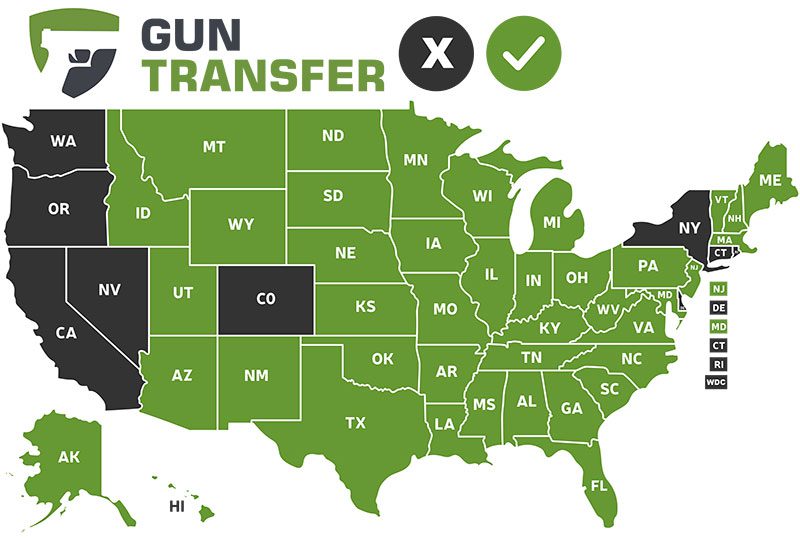
States that can use Gun Transfer
Understanding state gun laws is one of the most consequential responsibilities of any U.S. firearm owner. Federal rules apply uniformly across the country, but every state layers its own framework on top — and the cumulative result is that what is perfectly legal in one state may be a serious crime across the state line. State gun laws cover background check requirements for private sales, magazine capacity limits, concealed carry permitting, “assault weapons” classifications, waiting periods, training requirements, secure storage mandates, and dozens of other categories that vary dramatically from state to state.
This guide categorizes state gun laws into the major regulatory areas where states differ most, summarizes the general patterns, and explains how to find the specific rules for your jurisdiction. State law changes every legislative session, so the framework below is durable but the specifics for any individual state should always be verified against your state attorney general’s current guidance.
Why State Gun Laws Vary So Much
The Second Amendment establishes a federal floor for civilian firearm ownership, and Congress has built additional federal regulations on top of that floor through the Gun Control Act of 1968 and subsequent legislation administered by the Bureau of Alcohol, Tobacco, Firearms and Explosives. Within that federal framework, every state has independent authority to regulate firearm ownership in any way that does not conflict with federal law or the Constitution. The result is a fifty-state patchwork where political, cultural, and historical differences produce dramatically different state gun laws.
The U.S. Supreme Court’s decisions in District of Columbia v. Heller (2008), McDonald v. City of Chicago (2010), and New York State Rifle & Pistol Association v. Bruen (2022) have set increasingly clear limits on how restrictive state gun laws can become while remaining constitutional. Lower courts continue to work out exactly where the line falls for specific state statutes.
State Gun Laws: Background Checks for Private Sales
Federal law requires background checks for sales by licensed dealers but not for private-party sales between residents of the same state. State gun laws fill that gap differently:
- Universal background check states require all firearm sales — dealer or private — to go through a licensed FFL with a NICS background check. California, Colorado, Connecticut, Delaware, Illinois, New Mexico, New York, Oregon, Rhode Island, Vermont, Virginia, and Washington fall in this category, with several others having narrower versions of the rule
- Hybrid states require background checks for handgun sales but not for rifles and shotguns. Maryland, Pennsylvania, and a few others fall here
- Permissive states allow private-party sales between same-state residents with no background check requirement. The majority of states fall in this category
State Gun Laws: Magazine Capacity Limits
Several states limit the magazine capacity that civilians may legally possess, even on otherwise-lawful firearms. Common patterns:
- 10-round limits: California, Colorado, Connecticut, Hawaii, Maryland (handgun), Massachusetts, New Jersey, New York, Oregon, Vermont, Washington, and the District of Columbia
- 15-round limits: Illinois (Cook County and Chicago specifically), and a handful of others
- No state limit: most states
These state gun laws apply to both purchase and possession. Bringing a magazine across state lines that exceeds the destination state’s limit is potentially a felony even if the magazine is legal in the state of origin.
State Gun Laws: Concealed Carry Permitting
The right to carry a concealed firearm is granted by state gun laws, with enormous variation in how permits are issued:
- Constitutional carry / permitless carry states allow most adults to carry a concealed firearm without a permit. Roughly half of all states fall in this category as of recent legislative sessions
- Shall-issue states require a permit but must issue one to any qualifying applicant
- May-issue states grant permits at the discretion of state or local authorities, often requiring “good cause” beyond general self-defense interest. Hawaii is the primary remaining may-issue state after Bruen
Reciprocity between states — whether a permit issued in State A is valid in State B — is yet another layer that carriers traveling across state lines must check before each trip.
State Gun Laws: “Assault Weapons” Classifications
Federal law expired the assault weapons ban in 2004, leaving the classification entirely to state gun laws. States that maintain their own definitions of “assault weapon” and restrict ownership of those firearms:
- California, Connecticut, Hawaii, Illinois, Maryland, Massachusetts, New Jersey, New York, Washington, and the District of Columbia
Each state defines “assault weapon” differently. A firearm legal under one state’s definition may be banned under another’s. Owners moving between states with different assault-weapon laws sometimes have to surrender, sell, or modify firearms to remain compliant.
We handle the legal part for you.
You know the rules now — here’s the easy part. A real background check on the buyer, a signed bill of sale, and permanent records, done from your phone in about 10 minutes. Flat $50.
State Gun Laws: Waiting Periods and Permit-to-Purchase
Some states require a waiting period between purchase and delivery, a separate permit before any firearm acquisition, or both:
- Waiting periods (typically 3-10 days): California, Florida, Hawaii, Illinois, Maryland, Minnesota, New Jersey, Rhode Island, Vermont, Washington
- Permit-to-purchase / Firearm Owner ID required: Illinois (FOID card), Iowa, Massachusetts, New Jersey, New York
- Both: California (handgun safety certificate plus 10-day waiting period), New York (license plus checks at every transaction)
State Gun Laws: Secure Storage Mandates
A growing number of state gun laws require firearms in homes with children to be stored in specific ways — locked in a safe, secured with a trigger lock, or kept in a locked container separate from ammunition. Massachusetts, California, New York, Connecticut, and a number of other states have versions of these mandates, often with criminal liability if a child obtains and misuses an unsecured firearm.
State Gun Laws: NFA Items and Specialty Categories
Federal law regulates suppressors, short-barreled rifles (SBRs), short-barreled shotguns (SBSs), machine guns, and “any other weapons” (AOWs) under the National Firearms Act, with a $200 tax stamp and registration. State gun laws layer on top:
- Some states ban civilian ownership of suppressors entirely (California, Delaware, Hawaii, Illinois, Massachusetts, New Jersey, New York, Rhode Island, and DC)
- Some states ban SBRs even if federally registered (California, Delaware, Hawaii, Illinois, Iowa, Massachusetts, New Jersey, New York, Rhode Island, Washington, DC)
- Most states permit the federally-regulated NFA categories with the federal Form 4 process
State Gun Laws: Where to Find Current Requirements
State gun laws change every legislative session. The most reliable sources for current information are:
- Your state attorney general’s website (most states have a firearms-specific page)
- Your state police or department of public safety
- The ATF’s state-by-state rules page for federal interactions
- State-specific civilian rights organizations (NRA-ILA tracks state legislation; Giffords Law Center tracks the same from a different perspective)
For interstate travel with a firearm, the Firearm Owners’ Protection Act of 1986 provides limited federal protection — but the protection only covers travel through restrictive states, not extended stays, and the firearm must be unloaded and inaccessible to the driver throughout the trip.
Putting State Gun Laws Into Daily Practice
The practical takeaway from state gun laws is that compliance is location-specific and time-specific. The rules in your home state today are not necessarily the rules five years from now, and they are almost certainly different from the rules in the state next door. Three habits keep you on the right side of every variation:
- Subscribe to your state’s firearms law mailing list or follow your state attorney general’s news feed for legislative changes
- Before any cross-state travel with a firearm, check the destination state’s rules and any state you will pass through
- Document every firearm transaction completely so that if a question ever arises about which state’s rules applied at a specific moment, you have the answer
For more on the practical mechanics of safe and legal firearm transactions across the various state regimes, see our guides on gun transfer laws and 3 tips to protect yourself when selling a gun.

A handshake isn’t a transfer.
Make it legal.
In your state, the seller carries the federal liability. One undocumented sale to the wrong person is the difference between a clean record and 18 U.S.C. § 922(d). For \$50, you get proof you did it right.
- Real background check on the buyerMulti-source federal, state & county criminal + sex-offender records.
- Official bill of sale, signed by both partiesElectronic. Documented to hold up in court.
- Lifetime digital records in your Gun VaultPull them 5, 10, 20 years from now.
- Done from your phone in ~10 minutesNo gun-shop visit required in your state.
I almost burned half a Saturday driving to a gun shop. Instead I did it from my phone for fifty bucks.— Brandon T., verified seller
Secure checkout · No FFL markup · No range fees · Flat $50 every time.