






States Where You Can Transfer a Gun Online
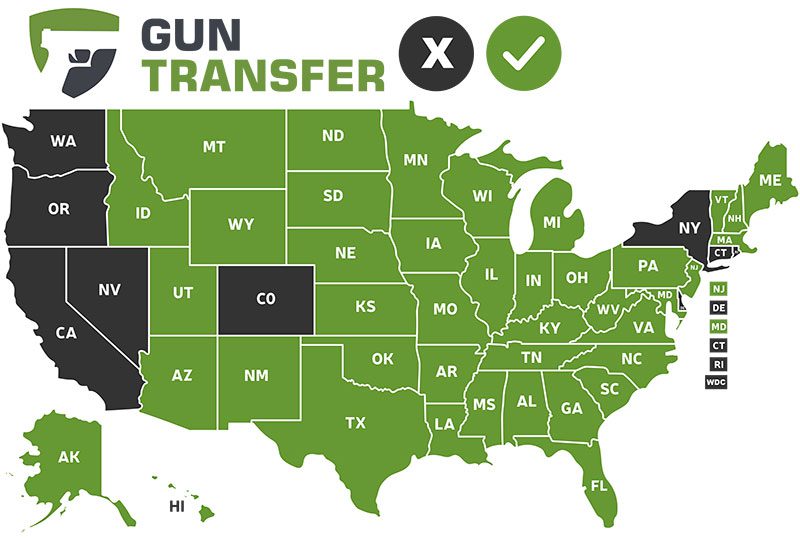
The list of states where you can transfer a gun online is determined by each state’s specific rules for private-party firearm sales — not by any federal restriction. Federal law allows private firearm transfers between residents of the same state without going through a Federal Firearms Licensee, but state law layers on top, and a roughly fifteen-state minority requires private transfers to go through a licensed dealer with a background check. Online gun transfer platforms like Gun Transfer America operate in the states where private-party transfers are legally permitted, and they handle the verification and documentation steps that protect both buyer and seller.
This guide covers which states currently support online gun transfer for private-party sales, which states require a different approach, and what the categories of state-level rules look like in practice. Coverage changes as platforms add support for additional jurisdictions, so for current real-time coverage check the platform directly. The general framework below stays stable.
How States Where You Can Transfer a Gun Online Are Determined
State-level rules for private firearm sales fall into three broad categories. Whether a state appears on the list of states where you can transfer a gun online depends on which category applies:
- Permissive states allow private-party firearm sales between same-state residents with minimal additional regulation. Most online gun transfer platforms operate fully in these states for rifles, shotguns, and handguns
- Hybrid states allow private long-gun (rifle and shotgun) sales freely but require handgun sales to go through a licensed dealer or follow a state-specific permit-to-purchase regime. Coverage in these states is partial — long guns yes, handguns no or with extra steps
- Universal background check states require all private firearm sales to go through a licensed dealer for a background check, regardless of firearm type. Online platforms either route through a partner FFL in these states or are not available
States Where You Can Transfer a Gun Online: Full Support
The following states permit private-party firearm transfers between same-state residents with verification and documentation, and online gun transfer services support all firearm types (rifles, shotguns, and handguns) in these states:
- Alabama
- Alaska
- Arizona
- Arkansas
- Florida
- Georgia
- Hawaii
- Idaho
- Indiana
- Iowa
- Kansas
- Kentucky
- Louisiana
- Massachusetts
- Michigan
- Minnesota
- Mississippi
- Missouri
- Montana
- Nebraska
- Nevada
- New Hampshire
- New Jersey
- New Mexico
- North Carolina
- North Dakota
- Ohio
- Oklahoma
- South Carolina
- South Dakota
- Tennessee
- Texas
- Utah
- Vermont
- Virginia
- West Virginia
- Wisconsin
- Wyoming
In each of these states, you can complete a private-party firearm transfer through an online platform that handles identity verification, background check on the buyer, eligibility confirmation, a state-compliant bill of sale, and permanent encrypted recordkeeping.
States Where You Can Transfer a Gun Online for Rifles and Shotguns Only
The following states permit private-party transfers of long guns (rifles and shotguns) but require handguns to go through a licensed dealer or follow a state-specific handgun permit process:
- Maine
- Maryland
- Pennsylvania
Sellers of long guns in these states can use online gun transfer platforms normally. Sellers of handguns must use an alternative process — typically the state’s specific handgun-purchase permit system or a licensed dealer.
We handle the legal part for you.
You know the rules now — here’s the easy part. A real background check on the buyer, a signed bill of sale, and permanent records, done from your phone in about 10 minutes. Flat $50.
States Where Online Gun Transfer Is Not Available for Private Sales
The following states require all private firearm sales to go through a licensed dealer with a background check, or have other regulatory requirements that online gun transfer services do not currently accommodate. In these states, you must use a licensed FFL for any private-party transfer:
- California
- Colorado
- Connecticut
- Delaware
- Illinois
- New York
- Oregon
- Rhode Island
- Washington
- Washington, D.C.
This list is not a permanent prohibition — it reflects current state law. As state legislatures revise their rules, and as online gun transfer platforms add state-specific compliance, coverage changes. Always check the platform’s current state list before assuming any specific state is or is not supported.
What Is Prohibited Across All States Where You Can Transfer a Gun Online
Regardless of which states where you can transfer a gun online support a given platform, federal law applies universally. Online gun transfer services do NOT support:
- Class II NFA Weapons / Title II Firearms — machine guns, short-barreled rifles, short-barreled shotguns, suppressors, “any other weapons” (AOWs), and destructive devices. These items require ATF approval (typically Form 4) and cannot be transferred through any online platform
- Buyers or sellers under 21 years old for handgun transfers (federal age minimum)
- Buyers or sellers under 18 years old for long gun transfers (federal age minimum)
- Anyone restricted from owning a firearm under federal or state law — felons, those convicted of domestic violence, certain mentally ill individuals, undocumented immigrants, and others enumerated in 18 U.S.C. § 922(g)
- Interstate transfers — federal law requires private transfers between residents of different states to go through a licensed FFL
The Bureau of Alcohol, Tobacco, Firearms and Explosives publishes detailed federal guidance on prohibited categories and on the requirements for NFA-regulated items.
How States Where You Can Transfer a Gun Online May Change
State firearm law evolves every legislative session. Some states tighten rules; others loosen them. Online gun transfer platforms expand coverage as they build out state-specific compliance — adding hybrid handgun support in a state that previously was rifle-only, or adding full coverage in a state that previously was unsupported. The list above reflects current general practice; individual platforms may have slightly different state coverage based on their specific compliance work.
If you are unsure whether your state allows online gun transfer, the cleanest answer is to start the platform’s signup flow with your state’s address — the system will tell you immediately whether it can complete a transfer in your jurisdiction.
Putting States Where You Can Transfer a Gun Online to Practical Use
If you are in one of the fully-supported states, online gun transfer is the responsible default for any private-party firearm sale. The platform handles identity verification, background check, state-compliant documentation, and permanent recordkeeping in a single ten-minute workflow. If you are in a hybrid or unsupported state, the alternative is to go through a licensed FFL — slower and more expensive, but legally required.
For more on the broader practice of safe and legal private-party firearm transactions, see our guides on 3 tips to protect yourself when selling a gun and gun transfer laws.

A handshake isn’t a transfer.
Make it legal.
In your state, the seller carries the federal liability. One undocumented sale to the wrong person is the difference between a clean record and 18 U.S.C. § 922(d). For \$50, you get proof you did it right.
- Real background check on the buyerMulti-source federal, state & county criminal + sex-offender records.
- Official bill of sale, signed by both partiesElectronic. Documented to hold up in court.
- Lifetime digital records in your Gun VaultPull them 5, 10, 20 years from now.
- Done from your phone in ~10 minutesNo gun-shop visit required in your state.
I almost burned half a Saturday driving to a gun shop. Instead I did it from my phone for fifty bucks.— Brandon T., verified seller
Secure checkout · No FFL markup · No range fees · Flat $50 every time.