







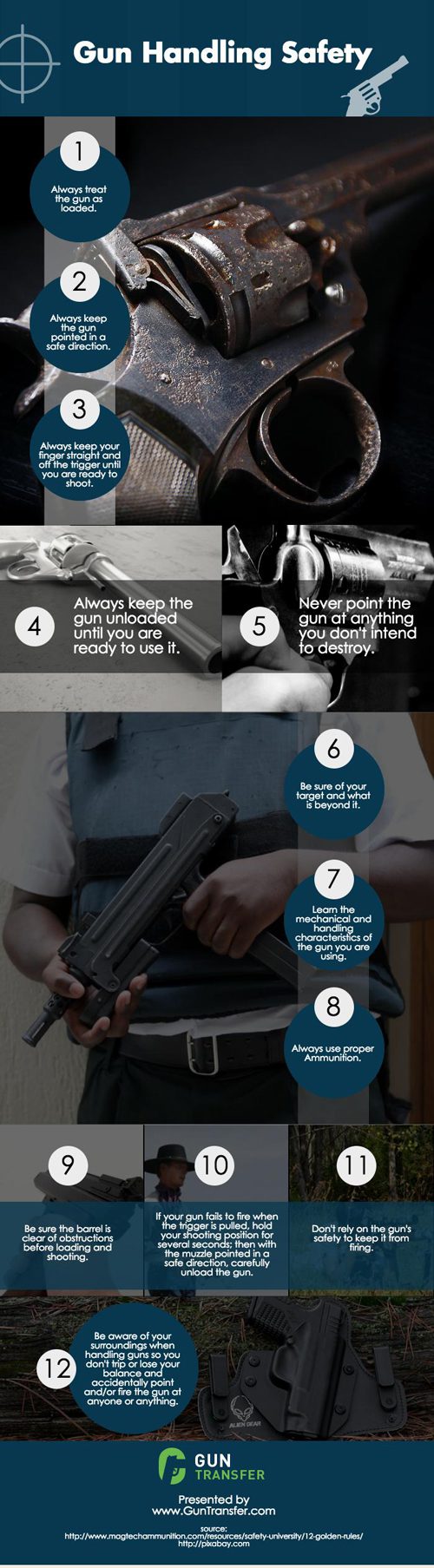
Gun Handling Safety Infographic
A clear gun handling safety infographic is one of the most useful tools any responsible firearm owner can keep at hand — for personal review, for sharing with new shooters, and for hanging in a gun room or training space where the rules stay visible. Knowing the safety rules is not enough. The rules have to become reflexes, applied the same way every time, regardless of how familiar the firearm feels in your hand. A gun handling safety infographic distills the rules into a format that is easy to remember and easy to teach.
The downloadable infographic at the end of this guide presents the core gun handling safety rules in one place, ready to print or share. The text below explains each rule in detail and the reasoning behind it.
Why a Gun Handling Safety Infographic Beats a Long Manual
Owners’ manuals are thorough but they get filed away after the first week of ownership. A gun handling safety infographic posted in plain sight does the opposite — it stays visible, gets reread without effort, and reinforces the rules every time you handle a firearm. Trainers, ranges, and the Bureau of Alcohol, Tobacco, Firearms and Explosives all emphasize that consistent reinforcement is what separates safe long-term gun owners from one-time class graduates.
For new gun owners specifically, a printed gun handling safety infographic in the room where the firearm is stored creates exactly the right kind of friction — every interaction with the gun starts with eyes on the rules.
The Four Universal Rules in Any Gun Handling Safety Infographic
Every credible firearms training program teaches the same four rules. They appear, with minor wording variations, in every major gun handling safety infographic and in the curriculum of every certified instructor:
- Treat every firearm as if it is loaded. The single most important habit. The vast majority of accidental discharges happen when someone “knew” a gun was unloaded — and was wrong. Treat it as loaded every time, no exceptions, even if you just checked it
- Never point the muzzle at anything you are not willing to destroy. Loaded or not, brand new or decades old, the muzzle is always pointed in a safe direction. In a home, that usually means the floor. At a range, that means downrange
- Keep your finger off the trigger until you are ready to fire. The trigger finger rests straight along the frame above the trigger guard until the muzzle is on target and the decision to fire has been made. Movies show characters with fingers on triggers; real-world handling does not work that way
- Be sure of your target and what is beyond it. A bullet that misses or passes through your target keeps going. You are responsible for every round that leaves the muzzle, whether it hits what you intended or not
These four rules are not negotiable, and they overlap intentionally. Even if one rule fails — you forget to check the chamber, for example — the others (muzzle direction, trigger discipline) will still keep you and the people around you safe.
The Safety Habits Behind a Good Gun Handling Safety Infographic
The four rules above cover handling. A complete gun handling safety infographic also addresses the habits and routines that prevent accidents in the first place:
- Verify the chamber and magazine status every single time you pick up a firearm — even if someone just handed it to you and said it was clear
- Unload the firearm before cleaning, transporting, or storing it
- Use only ammunition rated for your specific firearm — caliber stamped on the slide or barrel must match what is on the box
- Wear hearing and eye protection any time you are at a range or shooting outdoors
- Store firearms locked, unloaded, and separate from ammunition when not in use
- Never use alcohol or impairing drugs while handling a firearm
- Maintain the firearm — clean it after use, inspect for wear, and have a gunsmith look at any malfunction you cannot diagnose yourself
These habits become second nature with practice, but they need to be intentional at first. Posting a gun handling safety infographic in your storage area or training space gives you a constant reminder while the habits are still forming.
We handle the legal part for you.
You know the rules now — here’s the easy part. A real background check on the buyer, a signed bill of sale, and permanent records, done from your phone in about 10 minutes. Flat $50.
How to Use a Gun Handling Safety Infographic in Your Home
A gun handling safety infographic is most effective when it lives where you handle firearms — not buried in a drawer:
- Print and post it in your gun storage area, gun-cleaning bench, or anywhere else firearms are routinely handled
- Walk new gun owners through it the first time they handle the firearm in your home, regardless of their previous experience
- Review it before any range trip with someone who has not been shooting in a while
- Teach it to children in age-appropriate ways — the NRA’s Eddie Eagle program is a well-regarded resource for younger kids, and a gun handling safety infographic with simple language reinforces the same lessons
- Share it with friends who are new to firearm ownership — most accidents involving experienced owners start with a guest or family member who did not know the rules
Beyond the Gun Handling Safety Infographic: Building Real Skill
A gun handling safety infographic is a starting point, not a complete education. Knowing the rules and being able to apply them under stress are different skills, and the gap between them is filled with training. A defensive firearms course from a certified instructor — typically eight to twenty hours of classroom and range time — teaches the rules in context: how to draw safely from a holster, how to clear a malfunction, how to handle a firearm one-handed if your other hand is injured.
Range time after the course is what builds muscle memory. Plan to spend at least as much on training and ammunition in the first year of firearm ownership as you spent on the firearm itself. The owners who put time into formal training are not the ones whose names appear in stories about accidental discharges.
Download the Gun Handling Safety Infographic
Below is the full Gun Transfer America gun handling safety infographic. Click to view the full-size image; right-click and save the linked PDF to print at home.
Pairing the Gun Handling Safety Infographic with Other Safety Habits
A printed gun handling safety infographic is most useful when it sits inside a broader system of responsible ownership. The handling rules cover what you do with the firearm in your hands. Storage, training, and law-awareness cover the rest of the picture. For more on the storage side, see our guide on how to store guns safely at home. For the most common new-owner mistakes that the four rules are designed to prevent, see our guide on dangerous mistakes new gun owners make.
The bottom line is simple: every responsible gun owner already knows the four rules. The owners who stay safe over decades are the ones who keep them visible, keep applying them every time, and keep teaching them to everyone who handles a firearm in their home.

A handshake isn’t a transfer.
Make it legal.
In your state, the seller carries the federal liability. One undocumented sale to the wrong person is the difference between a clean record and 18 U.S.C. § 922(d). For \$50, you get proof you did it right.
- Real background check on the buyerMulti-source federal, state & county criminal + sex-offender records.
- Official bill of sale, signed by both partiesElectronic. Documented to hold up in court.
- Lifetime digital records in your Gun VaultPull them 5, 10, 20 years from now.
- Done from your phone in ~10 minutesNo gun-shop visit required in your state.
I sell a few firearms a year and want every one documented in case one ever comes up somewhere. Now they all are.— Phillip C., verified seller
Secure checkout · No FFL markup · No range fees · Flat $50 every time.