






Proper Way of Holding and Shooting a Gun
Mastering the proper way of holding and shooting a gun is the difference between a firearm that protects you when seconds matter and a firearm that becomes a liability under stress. A person who owns a gun hopes to never have to use it. In the event that a gun is needed for self-defense, the owner should be physically and mentally ready to use it correctly — to save a life, their own or someone else’s. Shooting to defend yourself is never glamorous, and few people fully internalize that you have to shoot to stop the threat, not to wound or warn.
Beyond the mental preparation, the actual proper way of holding and shooting a gun is a learnable physical skill. With consistent practice, you build muscle memory that holds up under stress. Without it, you tend to fumble exactly the way movies show characters fumble — and the consequences are real. This guide covers the proper way of holding and shooting a gun from safety verification through aiming, trigger control, and follow-through.
Safety First: The Proper Way of Holding and Shooting a Gun Starts Before You Aim
Every time you pick up a firearm — at home, at a range, in any context — the first three steps are non-negotiable:
- Treat every firearm as if it is loaded. Even if you just unloaded it. Even if someone hands it to you and says it’s clear. Always start from the assumption that a chambered round is present
- Keep the muzzle pointed in a safe direction. At a range, that means downrange. At home or in any other context, that means a direction where an accidental discharge would cause no harm — typically the floor
- Verify the chamber is empty before any dry-fire practice or handling. Drop the magazine, lock the slide back (or open the cylinder, or open the action), visually and physically inspect the chamber, then verify again before doing anything else
Only after these steps is it safe to begin practicing the proper way of holding and shooting a gun. The Bureau of Alcohol, Tobacco, Firearms and Explosives and every certified instructor program in the country teach these three rules in this order for a reason — they are the universal foundation that prevents accidents while you are building skill.
The Dominant-Hand Grip on the Firearm
The proper way of holding and shooting a gun starts with how the dominant hand makes contact with the firearm:
- The web of the dominant hand (the V between thumb and index finger) sits as high on the backstrap as possible, with no gap between the hand and the firearm
- The middle, ring, and pinky fingers wrap firmly around the front of the grip — strong but not crushing
- The thumb sits naturally along the side of the firearm, NOT crossing behind the slide on a semi-automatic (where slide bite can lacerate during firing)
- The trigger finger rests STRAIGHT along the frame above the trigger guard, NOT inside the trigger guard, until the muzzle is on target and the decision to fire has been made
The grip should be firm enough that the firearm does not shift in your hand under recoil, but not so tight that your hand trembles. Trainers often describe the right pressure as “a firm handshake” — strong, but not white-knuckled.
The Support Hand: Two-Handed Grip Done Properly
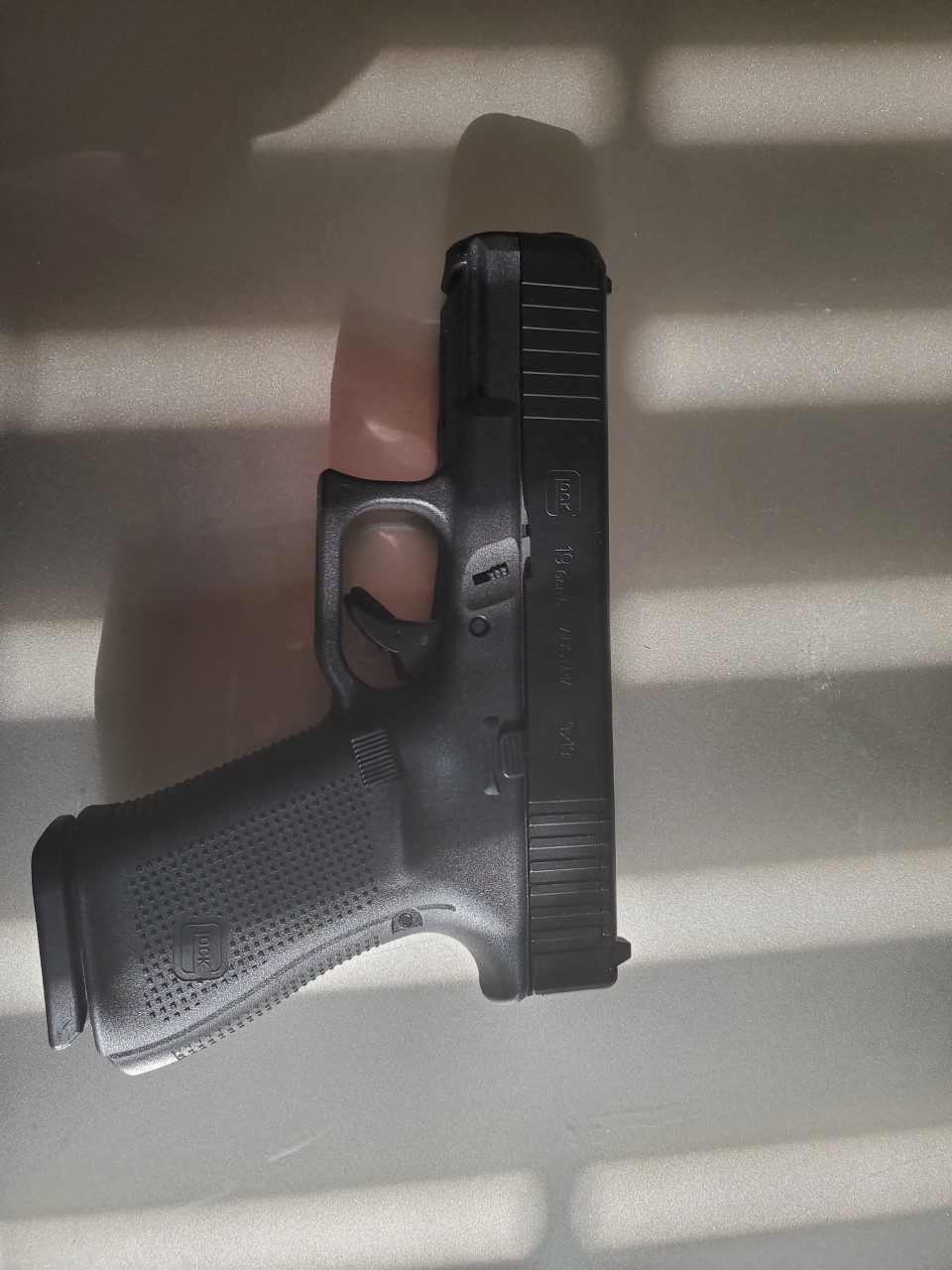
Shooting with both hands is the most stable and accurate way to fire any handgun. The non-dominant (support) hand fills the space the dominant hand cannot:
- The heel of the support hand fills the gap between the dominant hand’s fingers and the front of the grip
- The four fingers of the support hand wrap firmly around the dominant hand’s fingers
- The support thumb sits forward, parallel to the dominant thumb, pointing at the target
- Both thumbs stay clear of the slide path on a semi-automatic
A proper two-handed grip feels somewhat unnatural the first few times. That is normal. Within a few hundred dry-fire repetitions, the grip becomes automatic and the firearm becomes meaningfully more accurate and controllable than it would be with a one-handed or improperly-held two-handed grip.
The Proper Shooting Stance
Stance is what connects your grip to the rest of your body and gives you a stable platform to absorb recoil and reset for follow-up shots. The most common defensive shooting stance:
- Feet shoulder-width apart, with the dominant-side foot slightly back
- Knees slightly bent, weight forward on the balls of the feet
- Hips squared toward the target
- Shoulders rolled forward, leaning slightly into the firearm
- Arms extended forward but NOT locked at the elbows — a slight bend allows recoil to travel through the arms rather than the shoulders
This is sometimes called the “Isosceles” or modern combat stance. Older stances (Weaver, Chapman) work as well; what matters is that whichever stance you adopt, you practice it consistently so it becomes automatic.
Sight Picture and Dominant Eye Aiming
The proper way of holding and shooting a gun depends critically on aligning the sights correctly with your eye. Most people have a “dominant eye” — the eye that the brain prefers when targeting. Identify yours: extend both arms, form a triangle with your hands at arm’s length, frame a distant object inside the triangle, then close one eye at a time. The eye that keeps the object inside the triangle is your dominant eye.
To aim a handgun:
- Use your dominant eye as the primary aiming eye
- Bring the firearm up to eye level — do not lower your head to the firearm
- Align the front sight in the center of the rear sight (the front sight should fill the rear sight notch with equal light on both sides)
- Keep the front sight in sharp focus; the target and rear sight will appear slightly blurred. This is correct — your eye can only focus on one plane at a time, and the front sight is the plane that controls accuracy
Trigger Control: The Final Step in the Proper Way of Holding and Shooting a Gun
Trigger control is where most accuracy is won or lost. The center of the first pad of your index finger contacts the trigger — not the joint, not the tip. Pull the trigger straight back, smoothly, without disturbing the sight picture. The shot should almost surprise you when it breaks.
A useful technique while preparing to fire:
- From the aimed position, take up the slack in the trigger (the initial light pull before the wall) but do NOT cross the wall
- Confirm the sight picture one more time
- Continue the trigger pull straight back through the wall — the shot breaks
- Maintain pressure on the trigger after the shot fires; do not slap or release immediately
- Reset the trigger only enough to fire again if a follow-up shot is needed
This “press and hold” technique is what produces consistent accuracy across multiple rounds.
Follow-Through and Recoil Management
Mastering the proper way of holding and shooting a gun also means knowing how to recover after the shot. After the shot fires, your grip and stance keep the firearm under control during recoil and bring the sights back on target as quickly as possible. Constant practice is the only way to stabilize yourself against recoil and recover for accurate follow-up shots. New shooters often instinctively flinch in anticipation of recoil — pulling shots low and inconsistent. Dry-fire practice (verify chamber empty first, every single time) trains the trigger pull and grip without the recoil that causes the flinch.
Practice as the Real Foundation of the Proper Way of Holding and Shooting a Gun
Reading about the proper way of holding and shooting a gun is the start. Hundreds of repetitions on a range, with feedback from a qualified instructor, is what builds the skill. Plan to spend at least as much on training and ammunition in the first year of firearm ownership as you spent on the firearm itself. The owners who put in real range time develop the instinctive technique that holds up under stress; the owners who skip practice tend to be the ones who fumble in the moment.
For more on responsible firearm ownership beyond shooting technique, see our guides on dangerous mistakes new gun owners make and how to store guns safely at home.